Squeaking brakes in the morning or when it rains, is it dangerous? easy methods to check for worn brake pads by yourself before getting ripped off by repair shops
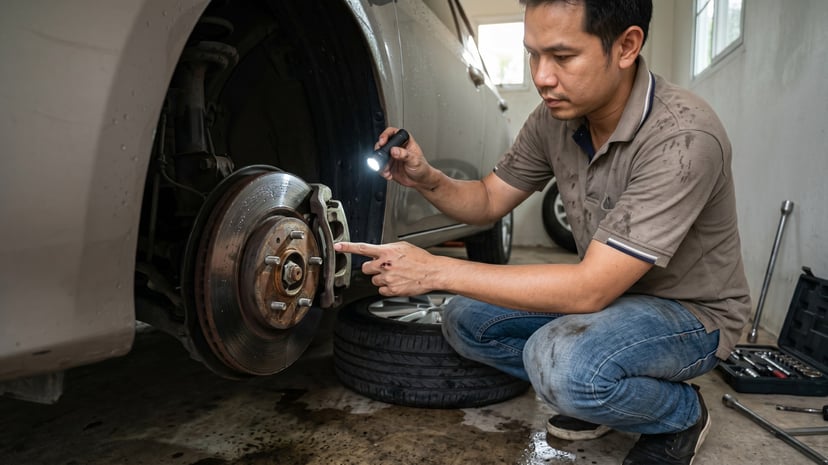
Squeaking brakes in the morning or when it rains, is it dangerous? easy methods to check for worn brake pads by yourself before getting ripped off by repair shops
For car lovers, even a tiny unusual sound during driving can cause massive anxiety. Especially "squeaking brake noises" in the morning right after starting the car or while driving through the rain. Many people lose confidence, wondering if the car's main safety system is having a problem? Or is this a warning sign that the brake pads are completely worn out?
where automotive technology has advanced greatly, including the widespread adoption of electric vehicles (EVs), the issue of brake noise remains a basic occurrence due to physical mechanisms. This article will help you understand the true cause of those noises, along with teaching you how to easily inspect the brake system by yourself to increase safety and provide you with the knowledge to talk to mechanics confidently without being tricked into changing unnecessary parts.
Simple Summary of Brake Noise Symptoms
- Loud only in the morning or when it rains: Caused by moisture and thin rust stains on the brake rotor surface. After driving for a while and braking 2-3 times, the noise will disappear on its own. "Not dangerous."
- Loud every time you step on the brake: Occurs because the brake pads are thin, causing the wear indicator to scratch against the brake rotor, or debris like small stones is stuck inside. "Should check urgently."
- Grinding noise like metals rubbing together: Brake pads are completely gone, causing the steel backing plate of the brake pad to directly eat into the brake rotor. "Very dangerous, do not continue driving."
- Initial check method: Look at the thickness of the brake pad material through the wheel spokes and observe the brake fluid level in the engine bay.
Why Do Brakes Squeak in the Morning or When It Rains? Deep Dive into the Real Cause
If your car has squeaking noises only during times when the weather is humid, in the morning after waking up, or after driving through the rain, but after driving for a while the noise disappears on its own, you can rest assured to a certain extent that "mostly it is not caused by worn brake pads."
Flash Rust Mechanism
Most car brake rotors are made of cast iron material, which is highly sensitive to reactions with oxygen and moisture in the air. When you leave your car parked overnight in a humid place or park it after driving through rain, moisture will quickly cause an oxide layer or thin orange rust to coat the surface of the brake rotor.
When you drive off in the morning and step on the brakes for the first few times, the brake pad material will scrub this thin rust stain off through the friction movement, causing a high-pitched "squeaking" noise. Once the rust stains are scrubbed off until the rotor surface returns to being smooth as before (usually after braking about 2-3 times), the noise will completely disappear on its own. This is a natural occurrence for the brake system and is not dangerous.
Knowledge tip for EVs: Electric vehicles often experience brake noise in the morning or when it rains more frequently than general fuel cars. Because EVs have a Regenerative Braking system that uses the motor to help slow down the car and retard speed to charge electricity back into the battery, the mechanical braking system (brake pads and rotors) is barely used in daily life. Therefore, moisture and rust stains accumulate on the brake rotors more easily.
Warning Signs! What Kind of Noise Tells You It's Real "Worn Brake Pads"
To differentiate between normal moisture symptoms and critical symptoms that require repair, listen closely to the characteristics of the noise as follows:
- Continuous Squealing: If there is a squeaking or chirping noise every time you step on the brake, no matter how long you drive it doesn't go away, or even when releasing the brake and driving normally there is still a faint, constant chirping sound, this is a sign that the "Acoustic Wear Indicator," which is a small steel tab installed by the manufacturer, has started to protrude and scratch against the brake rotor to warn that your brake pad thickness is less than 2 millimeters left.
- Grinding Noise: If you step on the brake and hear a dull noise like severe metal grinding, along with feeling a vibration up through your foot, it means your brake pads are completely gone down to the steel backing plate level. The steel plate is directly grinding against the brake rotor, which will cause deep scratches on the rotor, damage, and dangerously increase braking distance. It must be replaced immediately, and it may require resurfacing the rotor or replacing it with a new brake rotor altogether.
Easy Methods to Check for Worn Brake Pads by Yourself Before Going to the Auto Repair Shop
To prevent dishonest auto repair shops from taking the opportunity to rip you off by tricking you into replacing brake pads even though they are still thick enough, you can use these methods to check the truth by yourself first:
Method 1: Shine a light through the wheel spokes (Visual Inspection)
If your car uses alloy wheels with wide enough spaces between the spokes, use a smartphone flashlight to shine into the brake caliper area (the metal housing covering the brake rotor). You will see the brake pad attached to the circular steel brake rotor.
- Evaluation Criteria: Look at the thickness of the brake pad material (excluding the steel backing plate). If the brake pad material has a thickness of more than 4 millimeters or is thicker than a ten-baht coin, it means it is still usable normally. But if it looks as thin as a one-baht coin or has less than 2-3 millimeters left, it means it is time to change.
Method 2: Observe the brake fluid level in the engine bay
Open the front hood and look for the brake fluid reservoir (usually located on the driver's side near the firewall).
- Evaluation Criteria: The braking system is a closed system. If there is no leakage of brake fluid, the fluid level will drop relative to the thickness of the brake pads. Because when the brake pads become thinner, the brake piston must push out deeper, causing the brake fluid in the reservoir to be drawn down to replace it. If you find that the brake fluid level has dropped to the Min (minimum) line without any leaks, it is an initial indication that your brake pads might be near completion.
Method 3: Observe the pedal travel and feeling of the brake pedal
While driving, try to observe the feeling when your foot touches the brake pedal. If you feel that you have to press your foot deeper than usual for the car to start slowing down, or if the brake pedal feels unusually soft or spongy (Spongy Pedal), this might be caused by thinner brake pads, which increases the free play distance of the piston.
Summary Table of Brake Noise Symptoms and Solutions
| Noise Characteristics | Occurrence Period | Main Cause | Danger Level / Guidelines |
| High-pitched squeaking | Only in the morning / after rain; disappears after driving a while | Moisture stains and thin rust on the brake rotor | ✅ Not dangerous, no action needed |
| Long high-pitched chirping | Loud all the time, whether driving or stepping on the brake | Brake pad wear indicator pin starting to scratch the rotor | ⚠️ Warning, should replace brake pads within 1-2 weeks |
| Grinding, steel scratching noise | Every time weight is pressed onto the brake pedal | Brake pads completely worn out, backing plate scratching the brake rotor | 🚨 Very dangerous, do not continue driving, must replace brake pads and check rotors immediately |
| Rhythmic squeaking | Loud according to car speed, even without stepping on the brake | Warped brake rotor or small stone debris embedded in the brake pad material | ⚠️ Warning, should bring the car to a service center to resurface the brake rotor smoothly |
Conclusion
Squeaking brake noises in the morning or when it rains are mostly just "temporary symptoms" from weather conditions and the natural property of cast iron material, which poses no danger to the vehicle stopping system. However, regularly using your eyes to shine a light and check brake pad thickness and observing the brake fluid level by yourself will help you accurately evaluate the real situation of your car, help increase travel safety, and most importantly, serve as an excellent shield that helps you avoid falling victim to auto repair shops overcharging above reality.
Q&A Frequently Asked Questions About Brake Systems and Brake Pads
Q: Approximately how many kilometers is the lifespan of general brake pads?
: On average, front brake pads have a lifespan of approximately 30,000 - 50,000 kilometers, while rear brake pads are at approximately 50,000 - 70,000 kilometers. However, numbers will fluctuate greatly according to driving behavior (for example, people who drive in the city with heavy traffic and have to step on the brakes frequently will have their brake pads run out faster than those who run long distances in other provinces).
Q: When changing brake pads, is it necessary to "resurface the brake rotor" every time?
: It is not necessary to do it every time. Technicians will consider from the contact surface of the original brake rotor. If the brake rotor surface remains smooth, has no deep lines, and the original braking shows no steering wheel vibration symptoms, a new set of brake pads can be installed right away. But if the brake rotor surface has degraded into wavy patterns or is rough, resurfacing the rotor smoothly first will help the new set of brake pads grip the contact surface at full efficiency and reduce noise occurrences best.
Q: If the brake fluid drops, can we buy brake fluid to fill it up to the Max line ourselves?
: It is not recommended to fill it yourself immediately if there is no leak. Because as explained, the decrease in brake fluid is caused by thinner brake pads. If you add more brake fluid until it reaches the Max line, when the time comes for you to take the car to replace a new set of brake pads, the technician must push the brake piston back into place. This will cause the brake fluid to overflow and spill out from the brake fluid reservoir in the engine compartment. Brake fluid has a highly corrosive effect; if it overflows onto the car paint or plastic parts, it will cause damage. The best way is to leave it and let the technician check the brake pad thickness first.
Want a car valuation? Contact us to get a free car valuation within 24 hours…