How deep can an ev go? a deep dive into ip67 and 3 things you must never Do
How deep can an ev go? a deep dive into ip67 and 3 things you must never Do
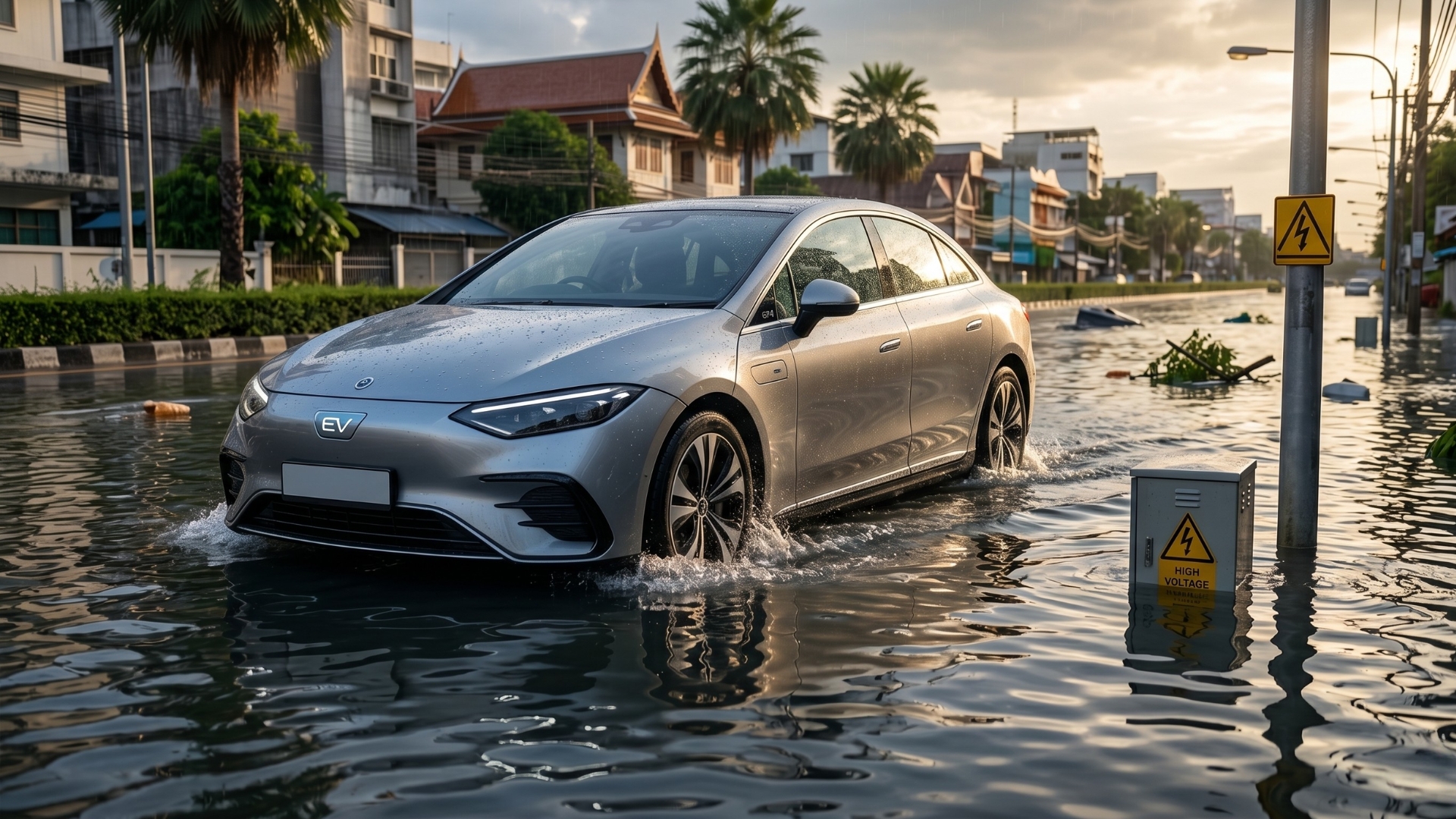
The rainy season in Thailand often brings unavoidable flooding. For Electric Vehicle (EV) owners, the biggest concerns are: "Can an EV drive through water?" and "Will the battery explode or fail if it gets wet?"
EVs now the primary mode of transport on our roads, understanding water protection technology and its limits is essential. This article explores the IP67 standard that protects the heart of your EV and the precautions that will save you from unnecessary repair bills reaching into the hundreds of thousands.
EVs and Water Wading: At a Glance
- IP67 Standard: The dust and water protection rating for batteries. The digit "7" means it can be submerged in 1 meter of water for 30 minutes in a static state.
- Safe Depths: EV sedans should generally not exceed 20-30 cm, while EV SUVs can handle approximately 40-50 cm (or no higher than half the wheel).
- The Real Risk: It’s not a battery explosion; it’s water seepage into the air conditioning unit or other electronic components that do not carry an IP67 rating.
- Urgent Advice: If water reaches the door sill, avoid the area immediately to prevent damage to the cabin systems.
What is the IP67 Standard in EVs? Why You Can Feel Secure
The heart of an electric vehicle is the High-Voltage Battery, usually mounted under the floor. Manufacturers design these battery packs to be hermetically sealed according to the IP (Ingress Protection) standard.
Breaking Down the "IP67" Code:
- 6 (Dust Protection): Completely dust-tight.
- 7 (Water Protection): Protects against water immersion up to 1 meter deep for a maximum of 30 minutes.
The Reality Check: This standard is tested in a lab with still water. In real-world flooding, "water pressure" from driving or waves created by passing vehicles can reduce this effectiveness. Therefore, IP67 is a "great shield," not a "free pass" to drive through deep water at will.
Depth Guide: "Safe to Go" vs. "Don't Even Try"
How deep your EV can wade depends largely on the vehicle type and its Ground Clearance:
Depth Level |
Status |
Impact on EV |
| 0 - 20 cm | ✅ Safe | Water is below the chassis; can drive through normally. |
| 20 - 40 cm | ⚠️ Precaution | Water reaches the chassis and motors; drive slowly and steadily. |
| 40 cm + | ❌ Dangerous | Water may enter the cabin and cooling systems. Avoid at all costs. |
3 Absolute Prohibitions: Avoid the Six-Figure Repair Bill
If you must drive your EV through a flooded area, experts warn of 3 behaviors that are strictly forbidden, as they can cause permanent electrical failure.
⛔ 1. Do Not Drive at High Speed
Many mistakenly believe that driving fast will "push" the water away. In reality, speeding through water creates a "Wave Impact." These high-pressure waves can force water past the rubber seals of the motors or wiring connectors, which are not designed to withstand high-impact water force.
⛔ 2. Do Not Turn on the AC in Deep Water
The cooling fans for the AC system are usually located at the front of the car. If water reaches the fan level while the AC is on, the blades will hit the water and break, or they may "splash" water into the alternator and other electronic components in the motor compartment. Turn off the AC and crack the windows slightly to reduce the load on the vehicle.
⛔ 3. Do Not Charge Immediately After Wading
When you get home, no matter how low your battery is, do not plug in the charger immediately if you have just driven through deep water. Moisture or mud may be trapped in the charging port. Introducing high-voltage electricity to a damp port can cause a Short Circuit. Always ensure the charging port is completely dry first.
Post-Flood Care for Your EV
Don't assume everything is fine just because the car is still running. Follow these steps:
- Wash the Underbody: Remove mud, debris, or dirt that could clog the battery pack's cooling vents.
- Check the Carpets: See if any water seeped into the cabin. Left unchecked, moisture can damage the ECU (Electronic Control Unit), which is often installed under the carpet or seats.
- Visit a Service Center: If you waded through water deeper than half the wheel, have a professional check the motor gear oil and various seals to ensure long-term trustworthiness.
Conclusion
Electric vehicles are designed to be safer than internal combustion engine (ICE) cars in floods because they lack exhaust pipes and air intakes where water can easily enter the engine. However, "prevention is always better than a cure." If the water is higher than half the wheel or you cannot see the road surface, choosing a different route or waiting is the smartest way to protect your wallet.
FAQ: Frequently Asked Questions
Q: Will I get electrocuted if my EV is in a flood?
: No. EV systems have extremely fast Circuit Breakers. If sensors detect even a tiny current leak, the system automatically disconnects the battery for passenger safety.
Q: Does insurance cover flood damage?
: Most Type 1 insurance covers natural disasters like floods. However, if it is proven that the driver "intentionally" drove into water deeper than the vehicle's limit, the claim may be denied.
Q: Is it true that EVs handle water better than gas cars?
: In the short term, yes, because there is no risk of water entering the engine. But in the long term, EVs have more delicate electronic systems, making post-flood maintenance vital.
Claim your free car valuation today!
Want a car valuation? Contact us to get a free car valuation within 24 hours…